by Steve Wages, CEO @ HurkleDurkle
Agency growth appears deceptively simple: win more clients, hire more talent, repeat. But there's a paradox every agency leader eventually runs into: the more work you win, the harder the agency becomes to operate. The business somehow becomes more difficult precisely because it is more successful.

Many agencies misread the symptoms of growth as operational problems. Resulting actions rarely solve the underlying problem, because the issue was never operational discipline. It's organizational design: the organization model that smoothly enabled exceptional creative work at six people was never built, nor optimized, to deliver that work efficiently at fifty or a hundred.
At some point, every successful creative agency hits this wall. The very organizational model that fueled its early success starts creating “sludge” or the things that slow you down. Operational complexity keeps climbing with more meetings, more process, more senior management, and more overhead costs. Time for creative quietly declines, then your best people begin to leave.
That's the operational inflection point this report is about: the moment growth reveals cracks in an operating model that was quietly working in your favor, but with growth is now quietly working against you. Understanding how to operate your model effectively will enable easier and predictable growth.
Two Different Models, Built for Two Different Jobs
The management theorist Henry Mintzberg made a distinction worth borrowing: an org. chart is not an org. model. A chart shows who reports to whom, hierarchically. While a model describes how an organization actually converts effort into output — a basic system of relationships, logic and methods, not just its structure. Of the org. models Mintzberg identified, two matter most for agencies, which I’ll refer to as the “Factory” model and the “Maker” model.
The Factory model is designed for predictability and optimized for efficient scale. It takes known inputs and turns them into identical, predictable outputs, over and over, with cost and risk driven down through process, oversight, and standardization. The Factory org. model, and its mirrored cultural behaviors, work because factory outputs don't vary; sameness is the point. Every improvement it makes chases the same goals: lower cost, less risk (efficiency), consistency, and predictability. They strive to maintain “certainty.”
The Maker model is built for the opposite job: solving unique problems that don't have a known answer. It’s optimized for thinking, making, and learning. Compared to the Factory model, this model can be highly inefficient due to its need for cycles of exploration, iteration, collaboration, and communications that reveal something new, rather than something repeated. Where the Factory model treats uncertainty as the enemy, the Maker model treats uncertainty as the very terrain it's designed to work in. Most importantly, while all models are capable of incremental innovation, the Maker model is the only model designed to deliver sophisticated innovation and creativity.
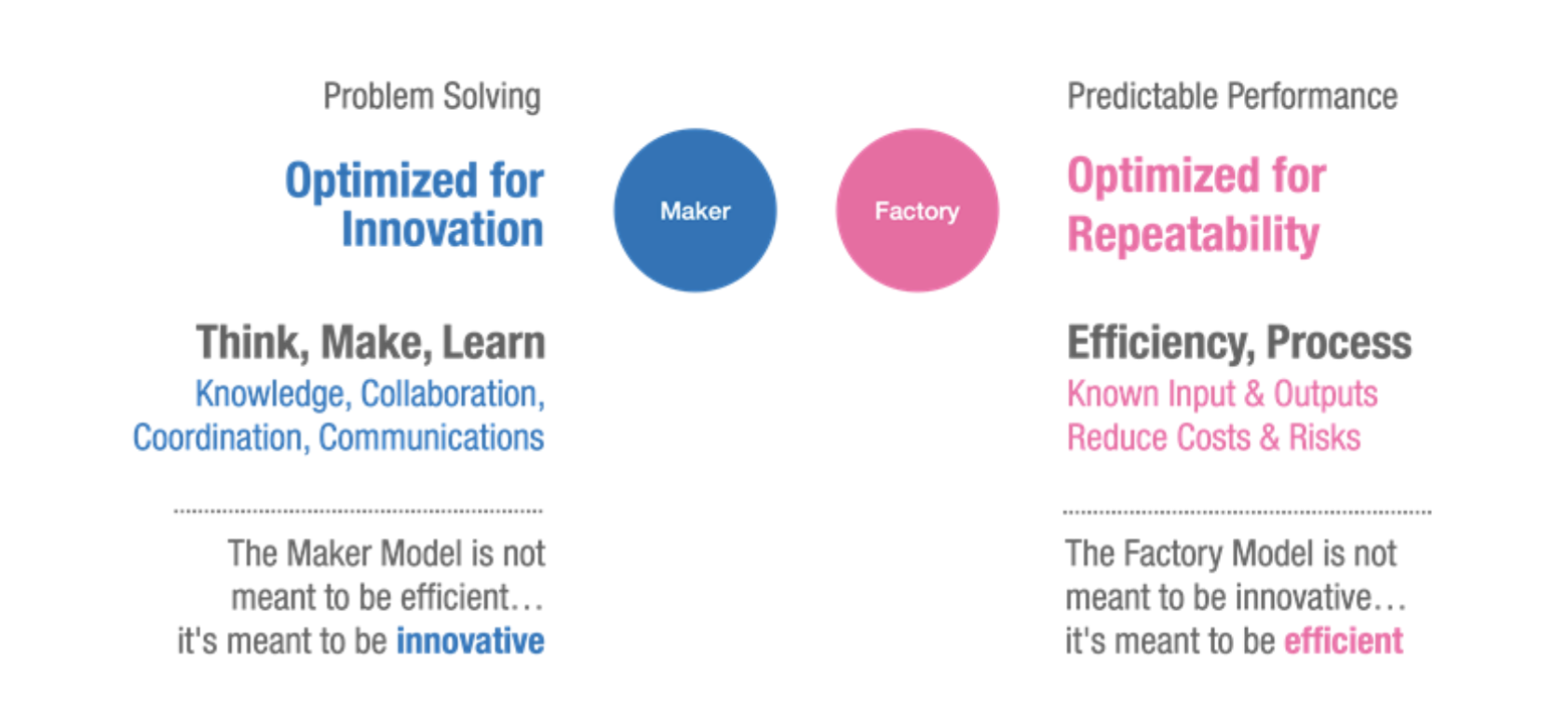
Neither model is better; they're just designed and optimized for different outputs. A factory that tried to innovate on every unit would be a bad factory. A creative team that tried to make every deliverable identical would be a bad creative team. The trouble starts when agency leaders, under pressure to scale, start judging and operating one model by the other's standards.
Why Clients Hire You in the First Place
Here's the detail that makes this more than an academic distinction: most agency clients are themselves Factory model organizations. They're structured for predictable performance, not sophisticated innovation, which isn't a flaw in their organization; it's simply not what their model is built to do. Factory organizations are actually optimized to not innovate, because innovation isn't repeatable, predictable, or efficient.
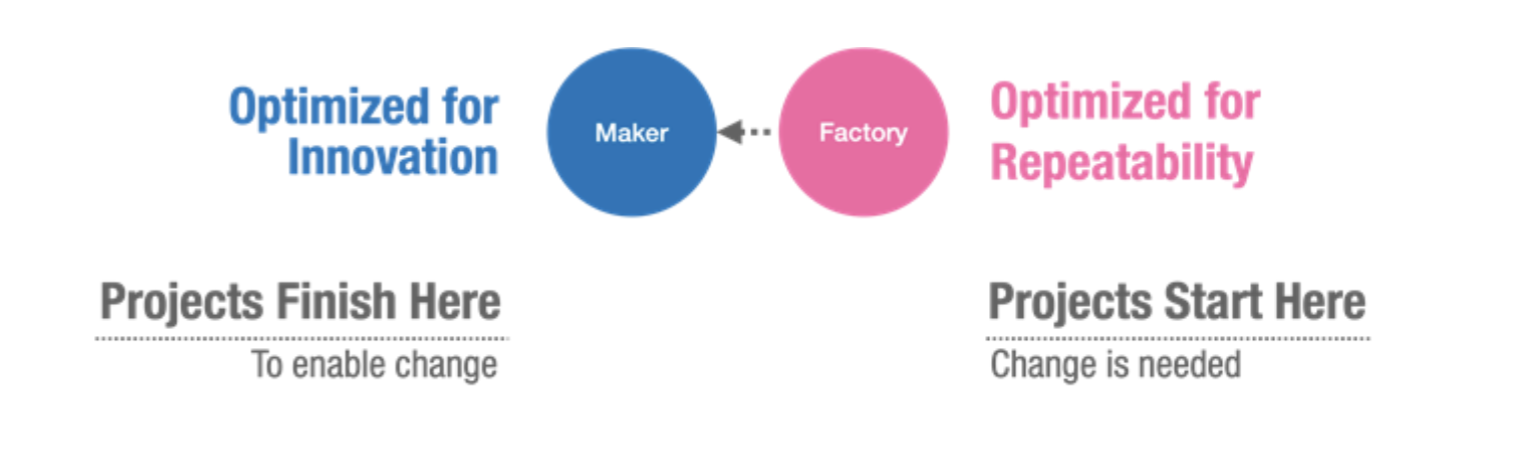
Which is exactly why, when they need to solve unfamiliar problems or imagine what no predictable process could generate, they form a project and come to you. But when faced with growth challenges, agencies often imitate the model that their clients hired them to compensate for.
Where Organizational Challenges Start for the Maker Model
Growth brings more people, more coordination, more complexity. Every new specialist adds communication paths, every new client adds coordination, and every new management layer adds decision points. Sludge increases. What once happened through a hallway conversation now requires an online tool or a full day of meetings. Overtime becomes normal. Productivity falls. Your best people grow unhappy.
Leadership responds by seeking predictability and control, understandably looking to how the client's Factory model achieves it. So, the agency imports the same control methods: more process, project software, management layers, documentation, schedules, tracking. Each decision seems reasonable in isolation. Collectively, they change the nature of the organization.
This is where operational debt quietly accumulates, long before it's visible. It doesn't first appear as a missed deadline or blown budget. It shows up as the slow erosion of Maker time. We accumulate debt by not taking the time to learn, then short-changing the time it takes to think. Eventually, only the "making" is left, kind of like a factory.
Scientific Management, the logic underneath the Factory model, is designed to strip variability and brainwork from the floor, since for a factory that variability is considered waste. But for a Maker model, that variability, the thinking, exploring, learning, is the product. Remove it in the name of control, and the agency doesn't become more efficient; it becomes less effective without gaining efficiency in return. The result is an organization stuck between two models, delivering on neither.
Work still gets done, often great work, but it gets harder. Margins tighten even as revenue rises. The agency increasingly behaves like a factory rather than a creative organization built to think. The irony is hard to miss.
Two Problems. Two Very Different Responses
As a Maker organization grows, its problems tend to come from two different sources, and distinguishing between them matters, because each requires an almost opposite response.
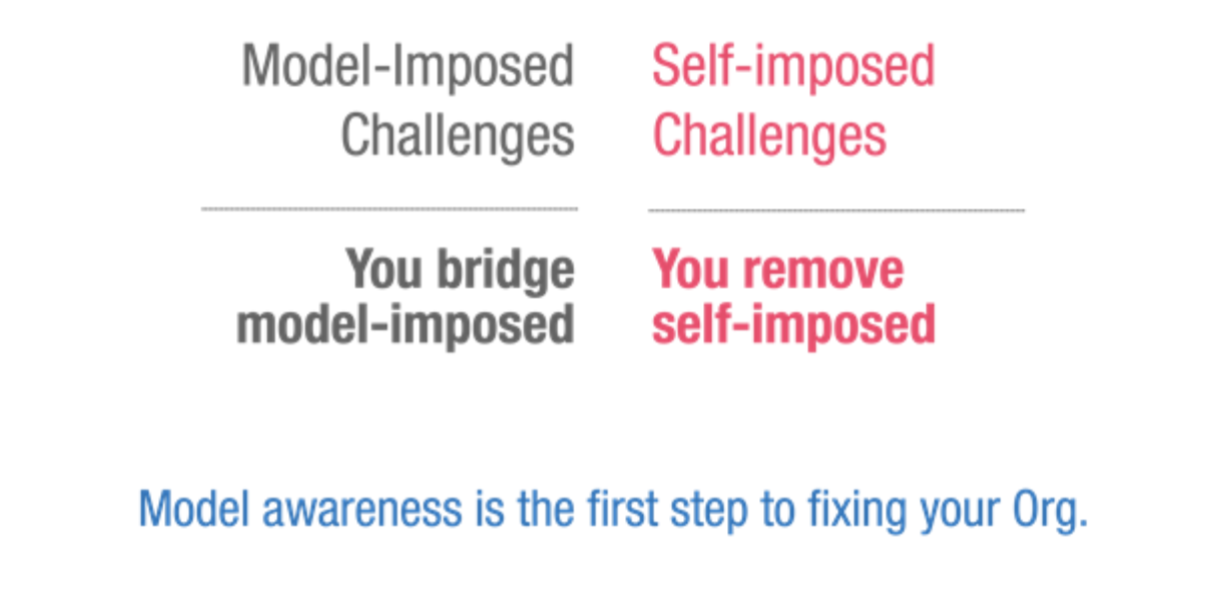
Model-imposed challenges are the natural tradeoffs of the Maker model itself. Every model optimizes for some things at the expense of others: the Factory model gains predictability through standardization; the Maker model gains creativity through exploration, iteration, and collaboration. Those same activities become harder to coordinate as the organization grows. That doesn't mean the Maker model can't grow; it means it doesn't scale naturally. Knowing how to operate a Maker org., means you don't eliminate what makes the model work; you bridge its limitations and easily grow. Factory organizations often bridge their innovation gap by hiring Maker organizations, like yours.
Self-imposed challenges aren't inherent to the model; they're created by how leaders try to solve the model-imposed ones. This is where growth challenges get amplified. Facing rising complexity, leaders reach for familiar tools of scale: more process, tighter schedules, higher utilization, more layers, more oversight. Borrowed indiscriminately from the Factory model, these restrict the thinking, exploration, and learning the Maker model depends on while adding more operational overhead. The original problem doesn't disappear; a self-imposed one gets layered on top of it. This distinction points to a simple approach:
Manage what the model imposes; remove what management has imposed.
Model-imposed challenges call for workarounds and deliberate operating choices. Self-imposed challenges call for identifying and reversing the sludge making the Maker model unnecessarily difficult to operate.
The difficulty is knowing which is which, but that’s not your fault. Most leaders have learned to scale through Factory model principles, since that's the dominant playbook. Far less has been written about scaling an organization whose advantage depends on uncertainty and human judgment. Without that understanding, leaders mistake natural tradeoffs for operational failures and attempt to manage them away. The result isn't a scalable Maker organization; it's a complicated hybrid that's lost the Maker model's advantages without gaining the Factory model's efficiencies.
The leadership challenge, then, isn't adding more operational discipline as the agency grows. It's understanding what the Maker model needs to work, protecting those characteristics, and redesigning everything else around them.
The Bottom Line
The model that makes sophisticated design, creativity, and innovation possible is not, out of the box, configured for growth. But that's not a flaw to be embarrassed about. It's a design fact, the same way a race car isn't designed to haul freight. The problem isn't that the Maker model struggles to scale. It's knowing which characteristics to protect, which to reconfigure, and which behaviors to embrace.
Three things are worth holding onto:
The Maker Model is an extraordinary competitive advantage. It’s also the most valuable tool in your creative toolbox. Operated well, it will enable everyone in your agency.
Growth exposes organizational design, not operational competence. When scaling gets hard, don't reflexively blame people or process, examine the organization model itself.
Operational discipline should support innovation, not replace it. The goal isn't more bureaucracy; it's removing unnecessary sludge while preserving the conditions that make sophisticated design/innovation possible.
You cannot outgrow your scale-related challenges. Doing nothing amplifies model-imposed challenges. Doing the wrong things creates self-imposed sludge. The cost of optimizing your org model is temporary; the cost of ignoring it compounds forever.
Growth-related challenges are inevitable in every Maker organization, but they are also manageable. The advantage belongs to leaders who recognize them before growth exposes them. The place to start is not by abandoning the model that made your agency successful, but by embracing it: understand how it really works, recognize where it struggles at scale, and deliberately optimize it for the growth you want to achieve.

Steve Wages, CEO, HurkleDurkle